
Why football? - An onlooker's guide
- Apr 20, 2016
- 5 min read
To use the words of that great football pundit David Mitchell, there is "Constant, dizzying, 24 hour, year long, endless football. Every kick of it massively mattering to someone presumably." But why do we become so invested in this and our respective clubs? Football means much to millions even billions of people around the globe but to others it is a mystifying concept which makes as much sense as the origins of the universe or why they don't serve gravy at southern chip shops. A friend from one of the duller backwaters of the country recently outlined to me why it was he didn't like football and how he struggled to comprehend why I would spend countless hours not only watching but incessantly talking about the sport and its intricacies, especially when the main topic of conversation was a club from a town which until recently he had no idea existed. His argument was twofold. Firstly, he didn't get the diving. Neither do I at times. He just disliked that aspect of the game and in comparison to a sport like rugby I have heard the argument before. However, his second reason peaked my interest far more: "How can you support, relate to, be interested in and follow a team in which you know none of the members personally?" and therefore should have no emotional connection with them. Such an argument is put forward by others who argue that their fortunes are even more difficult to relate to when they are paid incredibly large sums of money to play the game.
At first glance it makes little sense. Why should anyone care what an overpaid mercenary who you have never met does on a football pitch? As much as we like to think that players are loyal to our club, most of the time they will happily move onto the next club if they receive a greater wage in return. Their goals, passes, clean sheets and glory will only be garnered for your team as long as you continue to pay them. The sheer amount of money in the game has left some fans disillusioned with the game, keen to move back to the grass roots. Perhaps the best such example is FC United of Manchester, founded in 2005 by Manchester United fans who had become disenchanted with their local multinational corporation following its purchase by the Glazer family. FC United have risen dramatically through the lower leagues in recent years and currently sit just two tiers below the football league. Speaking to one FC United fan he said that as much as it was nice for the club to win games, he felt that some fans are fearful that success could soon begin to take away what was special about the club. Bringing the money and commercial interests from which its fans had desperately seeked an escape from. Such concerns were also demonstrated in the BBC One documentary, Class of '92: Out of Their League where five former Manchester United players / legends (depending on how much you like to use the term) bought Salford City FC, with some supporters initially hostile to their arrival. At FC United fans can not only have a say in how the club is run but roles and jobs are filled in by fans - members of the community. Possibly the reasons for FC United's existence also partially demonstrate why it is that fans still continue to support teams in an environment so influenced by money and the balance sheet.

To many, the first thing which comes to mind when someone speaks of Stoke, Blackburn or Hartlepool are their respective football teams. Football clubs have traditionally been a key part of communities across Europe. Unlike the franchise system in America where owners are able to uproot teams and transport them to the other side of the continent, football clubs such as those in England have grown been present since the late 19th century and have become seen as permanent fixtures of the local community. Football clubs not only put towns, cities and regions on the map and act as a surrogate measure of success for those towns but also are inextricably linked to the people within the local area.
Clubs can be seen as a further extension of the local community, often representing a certain set of ideals to which its members and supporters subscribe such as St. Pauli in Hamburg. Writing about Spartak Moscow, Robert Edelman describes how supporting the club was a means of being separate from the Soviet state for periods of time even if this did not mean you actively opposed it. "A small way of saying 'no'" to the state. On the other hand, football not only acts as an escape from daily life and an identification of ideals but also as a unifier where people can put aside their political differences and enjoy the journey of success and failures as a united mass, from the same area. Large scale sporting events are one of only a few occasions in society nowadays when communities come together in one place in large numbers.
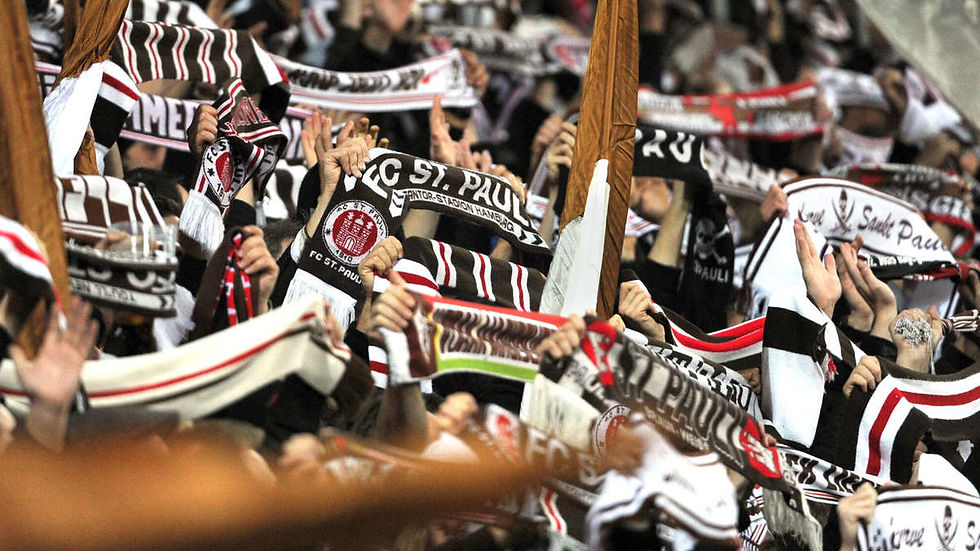
Although one could argue that being proud of your local area and in fact your country can be irrational, it no doubt wields a sort of power over people. Growing up in a certain area feeds in to your beliefs and makes up a portion of what people are and by extension this shared belonging to a community motivates fans to travel across the country on a Tuesday evening to watch their side get turned over. This idea that football isn't just a game makes sense when you look at how deeply ingrained it has become in English society and despite the fact that not everyone subscribes to it, being a part of a football club stretches past those 90 minutes on a Saturday afternoon.
Supporting a team in a sort of local pseudo-nationalist ferver may appear irrational to a passive onlooker, unable to comprehend the point of it all. To an extent it is. We are so transfixed by something which we the fans cannot influence and experience a disconnect with the agents who play on the pitch. As a fan, although not specifically taking part in the match there is an illusion that you are doing so, contributing to and being part of a community or at least enjoying a shared experience. I imagine that this sort of connection is something which the supporters of FC United felt that they had lost as the Mancunian multinational behemoth has grown into something which they no longer recognised as an extension of themselves and their community. Clearly those who continue to follow their respective teams in the commercial age still feel that these traditional reasons behind their support have not been entirely eroded and may continue to be the bedrock behind which support is based. It will be interesting the see if fans become consumers and pawns (are we there already?) or whether the current values behind support continue into the future.
Although the channel is hit and miss overall, Copa 90 on Youtube have produced the fantastic 'This is...' series highlighting what it is that makes football clubs around the world, from Partisan Belgrade to Napoli. The theme and role differs clubs to club regarding their specific political, social and economic impact but a common thread of community can be found throughout.
Despite all the endless stats, transfers, tactics and games football isn't necessarily always about football. Breaking down our enjoyment may kill some of the romanticism but also shows what lies at the heart of a most national institution. Although fans do not know players personally and in some cases may be mercenaries with little regard for the club there are reasons as to why clubs and the game mean so much to loyal supporters. Humans are social creatures, which enjoy being a part of a shared community with friends and family and in localised circumstances place value upon where we originate from with such notions having power amongst supporters of clubs from The Champions League to the Combined Counties.


Comments